Table Of Contents
▲Top CEOs and Their Degrees: What Today’s Leaders Studied
We all have role models whom we look to as we strive to succeed in life. Their energy is strong, motivating us to pursue something significant in our professional journey. CEOs and their degrees are the pathway that provides the strongest inspiration to achieve our end goals. You might have heard about the successful CEOs who were dropouts but are running multimillion-dollar companies. How?
According to a Harvard Business Review report, only 8% of CEOs reached their position without a college degree. This is one key fact: education is the keystone to making an individual employee-worthy. This applies to CEOs as well. But the real question arises:
What qualification certifies one to get their level?
What degrees help in being a CEO?
This article will provide you with details to help you get to the top of your career and pave your path toward becoming a successful CEO.
Defining Chief Executive Officer
A Chief Executive Officer (CEO) is the highest-ranking executive responsible for setting an organisation’s vision, strategy, and overall direction. The CEO oversees major business decisions, ensures operational efficiency, and aligns leadership teams with long-term goals.
In modern organisations, CEOs and their degrees often reflect strong academic foundations in management, finance, engineering, or related fields. Their education and experience together enable effective governance, stakeholder management, and sustainable business growth.
Who is a Chief Executive Officer?
A Chief Executive Officer (CEO) is the highest-ranking executive in an organisation, responsible for overall leadership and strategic direction, and CEOs and their degrees often reflect strong academic and professional foundations. The CEO sets long-term goals, defines the company’s vision, and ensures alignment with its mission, with CEOs and their degrees supporting strategic and informed decision-making.
They oversee senior management and make critical business decisions, where CEOs and their degrees contribute to effective leadership and governance. The CEO also represents the organisation to stakeholders, investors, and the public, and CEOs and their degrees help build credibility and trust.
Ultimately, they are accountable for the company’s performance and success, with CEOs and their degrees playing a key role in shaping their leadership capabilities.
What Top CEOs Have Studied?
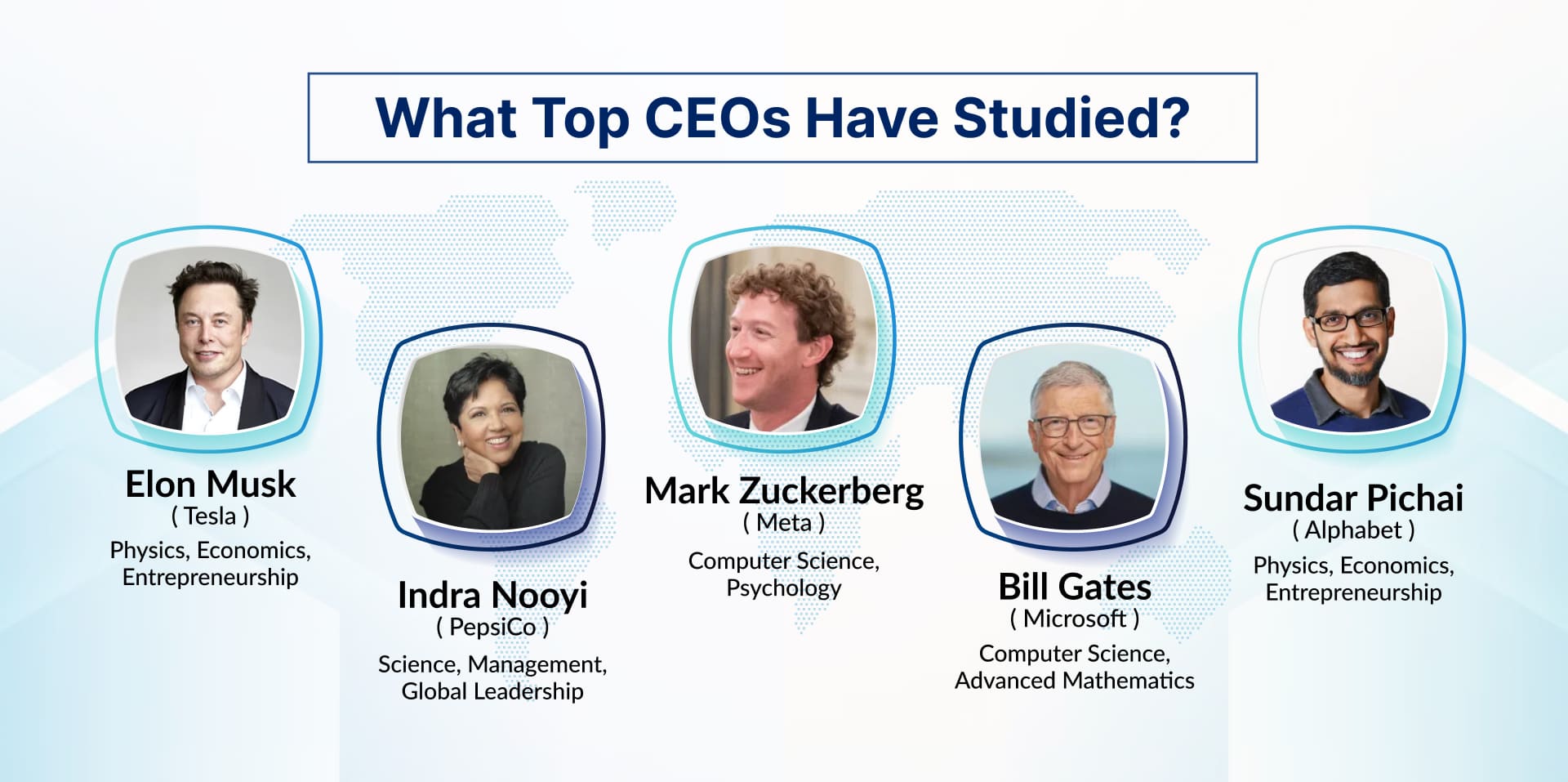
With many companies, we have several notable examples of leaders. However, the core idea of this article makes one thing clear: there is no single degree or predefined academic path that guarantees a journey to the CEO position.
In simple words, there is no cookie-cutter formula to crack this. It would be interesting to examine their educational history and how that education shaped who they are today. As this is starting to sound interesting, let’s take a closer look at CEOs and their degrees.
1. Sundar Pichai
Company’s CEO
Educational Qualification
B.Tech in Metallurgical Engineering from IIT Kharagpur, MS in Materials Science and Engineering from Stanford University, and an MBA from the Wharton School, University of Pennsylvania.
Road to the Peak
What may seem like a simple story of a boy from Madurai rising to the top is, in reality, a journey defined by grit and determination. He began his career at Google in 2014 and steadily advanced by deepening his understanding of the business and assuming critical development roles. Over the years, he contributed significantly to key products, including Google Chrome and the Android platform, which played a vital role in shaping his leadership trajectory.
Lessons to learn from Mr Pichai
A combination of engineering and management education can pave the way to global leadership roles. Few could have imagined that someone who began their journey studying the science of metals and alloys would go on to lead one of the world’s most influential technology companies.
This remarkable transition highlights how strong technical foundations, when paired with strategic thinking and adaptability, can unlock limitless leadership potential.
2. Indra Nooyi
Company’s CEO
Pepsico
Educational Qualification
She earned her bachelor’s degree in Physics, Chemistry, and Mathematics from Madras Christian College, followed by a Post Graduate Diploma in Management from IIM Calcutta, and later completed a master’s degree in Public and Private Management at the Yale School of Management.
Road to the Peak
Indra was a woman with a clear vision and unwavering ambition. Her career journey included impactful roles at leading organisations such as Johnson & Johnson, Boston Consulting Group (BCG), Motorola, and Asea Brown Boveri (ABB). She later began her iconic tenure at PepsiCo, where she steered the company’s global strategy for over a decade and played a pivotal role in navigating one of the most complex restructuring phases in its history.”
Lessons to Learn from Ms Nooyi
“The fusion of technical knowledge and business acumen creates powerful leaders, especially in a world where values-driven leadership matters more than ever.
Instead of relying solely on sugary sodas, she reshaped PepsiCo’s portfolio by championing healthier snacks and beverages such as Tropicana and Quaker Oats, a bold and controversial move at the time. Despite critics, the strategy ultimately succeeded, transforming PepsiCo into a more diversified and forward-looking global brand.
3. Jeff Bezos
Company’s CEO
Amazon
Educational Qualification
Jeff Bezos earned a degree in Electrical Engineering and Computer Science from Princeton, which provided him with the technical foundation to recognise the Internet's transformative potential long before it became mainstream.
Road to the Peak
Jeff Bezos began his career on Wall Street, working at firms like Fitel, Bankers Trust, and D.E. Shaw, where he gained invaluable experience in finance and technology. Driven by his vision of the Internet’s potential, he left a high-paying job to start Amazon as an online bookstore in 1994. Through relentless innovation, strategic risk-taking, and a customer-first approach, he transformed Amazon into one of the world’s largest and most influential companies.
Lessons to Learn from Mr Bezos
A deep understanding of technology, combined with a strategic vision, is essential for scaling a business and driving effective leadership.
4. Elon Musk
Company’s CEO
Tesla
Educational Qualification
Dual bachelor’s degrees in Physics and Economics from the University of Pennsylvania
Road to the Peak
No list of top CEOs would be complete without Elon Musk. He began his entrepreneurial journey by founding Zip2, went on to launch several groundbreaking ventures, including SpaceX, and eventually became CEO of Tesla. Each of his companies has become legendary, serving as case studies in innovation, leadership, and visionary business strategies.
Lessons to Learn from Mr Musk
: Elon Musk teaches us the power of relentless innovation and bold risk-taking. His journey shows that vision combined with perseverance can turn seemingly impossible ideas into global successes.”
5. Leena Nair
Company’s CEO
Chanel
Educational Qualification
Bachelor’s degree in Electronics and Telecommunication (E&TC) Engineering from Walchand College of Engineering, followed by an MBA from XLRI – Xavier School of Management.
Road to the Peak
She began her career as a summer intern at Unilever, steadily rising through the ranks to become Executive Director and Vice President of Human Resources. In just two years, she drove a 33% increase in productivity and played a key role in enabling women to return to work after career breaks through the “Career by Choice” initiative. Her upward trajectory continued as she made history by becoming the first woman, the first Asian, and the youngest-ever Chief Human Resources Officer. During her tenure, Unilever achieved a landmark 50/50 gender balance across global leadership and management positions.
She later created another milestone by becoming the first female and Indian-origin CEO of Chanel, despite having no prior experience in the fashion industry. At Chanel, she emphasised sustainability, brand exclusivity, and gender equality, guiding the organisation toward its ambitious goal of achieving net-zero carbon emissions by 2040.
Lessons to Learn from Ms Nair
Despite her remarkable achievements, pursuing education was a constant negotiation for her. From a small town in Kolhapur, Maharashtra, she became the first woman in her family to study engineering and was allowed to continue only after agreeing to marriage, through which she met her life partner, Kumar Nair.
6. Steve Jobs
Company’s CEO
Apple
Educational Qualification
Steve Jobs studied calligraphy, design and philosophy.
Road to the Peak
Steve Jobs was marked by vision, setbacks, and relentless innovation. After being ousted from Apple, he returned stronger, redefining technology with products like the iMac, iPod, iPhone, and iPad. His obsession with design, simplicity, and user experience ultimately transformed Apple into one of the world’s most influential companies.
Lessons to Learn from Mr Jobs
Education goes beyond degrees—it is driven by constant curiosity. Thinking differently and challenging conventions can take you a long way.
7. Uday Kotak
Company’s CEO
Kotak Mahindra Bank
Educational Qualification
Kotak completed his undergraduate studies in commerce at Sydenham College and went on to pursue management education at the Jamnalal Bajaj Institute of Management Studies.
Road to the Peak
Uday Kotak began his entrepreneurial journey by co-founding Kotak Mahindra Finance, transforming it from a non-banking finance company into one of India’s leading private-sector banks. Through disciplined risk management and long-term vision, he built Kotak Mahindra Bank into a symbol of trust and financial stability.
Lessons to Learn from Mr Kotak
Uday Kotak’s journey highlights the importance of financial discipline, long-term thinking, and ethical leadership. His success proves that sustainable growth is built on trust, patience, and strategic decision-making.
8. Neal Mohan
Company’s CEO
YouTube
Educational Qualification
Neal Mohan holds a Bachelor of Science in Electrical Engineering along with a Master of Business Administration (MBA) from Stanford University.
Road to the Peak
Mohan began his professional journey at Accenture before joining the startup NetGravity. Over the years, he rose through the ranks to become CEO of YouTube, playing a key role in expanding the platform through offerings such as YouTube TV, YouTube Music, YouTube Premium, and YouTube Shorts.
Lessons to Learn from Mr Mohan
“During his childhood, he returned to India around the seventh grade, where he initially struggled to fit in. His accent made him stand out, but this cultural transition became a defining experience that later helped shape his global outlook and inclusive leadership style.
9. Bill Gates
Company’s CEO
Microsoft
Educational Qualification
Bill Gates completed graduate-level computer science coursework and the advanced Math 55 program at Harvard University (dropout).
Road to the Peak
Not an ordinary story, but the iconic journey of a dropout who became one of the youngest billionaires. Certain about his vision, Bill Gates left Harvard to pursue his dream, founding Microsoft, which went on to become a global success.
Lessons to Learn from Mr Gates
Curiosity and hands-on experimentation can shape your future. As a teenager, Bill Gates explored early computers like the PDP-10, even pushing system limits to learn how they worked—an experience that sharpened his programming skills and laid the foundation for his success in software.
10. Mark Zuckerberg
Company’s CEO
Meta
Educational Qualification
Graduate in Computer Science and Psychology at Harvard University (dropout)
Road to the Peak
Known as a coding prodigy, Mark Zuckerberg built software to solve everyday needs, gaining major momentum during his Harvard years with projects like CourseMatch and the controversial Facemash. Recognising the potential of what became Facebook, he dropped out to scale it globally and later went on to shape the future of social technology through the metaverse and other platforms.
Lessons to Learn from Mr Zuckerberg
While still in school, Mark Zuckerberg created a program for his father’s dental clinic and his family home—an internal messaging system called “ZuckNet.” This early project revealed his natural inclination toward building communication tools from a young age.
What Can Students Learn From CEOs and Their Degrees?
These leaders prove three critical principles that challenge conventional wisdom:
The education and career paths of these top CEOs clearly show that there is no single formula for success. Here are the key lessons students can take from CEOs and their degrees:
Your degree does not limit your future
Sundar Pichai moved from metallurgy to leading a global tech giant, proving that foundational skills matter more than specialisation labels.
Blend technical skills with business thinking
Leaders like Indra Nooyi and Jeff Bezos combined analytical education with strategic vision to drive long-term growth. These CEOs and their degrees define professional growth and exceptional success.
Take calculated risks early
Elon Musk and Bill Gates succeeded by betting on ideas others considered uncertain or premature.
Career paths don’t need to be linear
Leena Nair, a prime example among CEOs and their degrees, transitioned from engineering and HR to leading a global luxury brand, showcasing the power of adaptability and versatile expertise.
Curiosity is a lifelong advantage
Steve Jobs proved that learning beyond formal education can fuel innovation and creativity.
Discipline and ethics build sustainable success
Uday Kotak highlights how patience, integrity, and long-term thinking create enduring institutions.
Global exposure shapes inclusive leadership
Neal Mohan, a notable example of CEOs and their degrees, demonstrates how cultural adaptability enhances leadership and drives success in global organisations.
Key takeaway for students:
Focus on building transferable skills, stay curious, embrace unconventional paths, and use education as a foundation, not a boundary. Success depends more on mindset, adaptability, and execution than on the name of your degree or institution.
Bottom Line:
There is no single formula for becoming a successful CEO. While many renowned leaders have built strong academic foundations in engineering, business, finance, or multidisciplinary fields, others have followed unconventional paths and still reached the top. What truly differentiates them is not only their qualifications but also their vision, resilience, strategic mindset, and ability to adapt to a constantly evolving business landscape.
A significant number of CEOs hold a Master of Business Administration across diverse specialisations. For those driven by passion and flexibility in today’s fast-paced world, online degrees offer an ideal solution. Through Online programs, learners can pursue accredited learning from renowned universities such as Amity University, Manipal Academy of Higher Education, Manipal University Jaipur Jain University Lovely Professional University, NMIMS Global, and Sikkim Manipal University.
If you’re considering taking the next step in your academic or professional journey, explore our courses—designed with inspiration from top CEOs and their educational backgrounds, reflecting the paths that have shaped today’s most successful business leaders—to find the right path forward.
FAQ
Which type of degree do most CEOs have?
What profession do most CEOs come from?
Is CEO the richest job?
Enroll with Us

Recent Blogs
Confused about your career path?
Connect with an expert counsellor today!
LIFETIME FREE
Our Top Mentor

⭐ 4.7
Ravinder Kumar
4 years experience
Sr. Mentor MCA

⭐ 4.6
Anuj Chand
6 years experience
Sr. Mentor BBA

⭐ 4.6
Dhruv Pahwa
4 years experience
Sr. Mentor MCA

⭐ 4.8
Ruchi Parashar
5 years experience
Sr. Mentor BCA

Categories
- > Online MBA
- > Online MCA
- > Online M.Sc
- > Online BBA
- > Online BCA
- > Online BA
- > Online PGDM
- > Online Certifications




Trending Search
- > Online MBA Fees 2025
- > Online MBA Admission Process
- > Online MBA Syllabus
- > Online BBA Fees 2025
- > Online PGDM Fees 2025
- > Best Online PGDM Colleges in India
- > Best Online BCA Colleges
- > Online BCA Admission 2025
- > Online BA Admission Process
- > Best Online MA Programs
- > Best Online Universities in India
- > Online Degree Courses in India
- > Best Online Courses for Working Professionals
- > Career after Online MBA
- > Online BBA Program
Tags
- > CEO and their degrees
- > Educational background of CEOs
- > Degrees of top CEOs
- > CEO education and career path
- > CEOs success stories



At MBA Query, we are delighted to help students with their admission journey. We offer proper guidance on choosing management programs, selecting ideal specialisations, and crafting a smooth, step-by-step application.
Top Universities
Best Online Courses
Opening Hours
10:00 AM - 7:00 PM
Monday - Saturday
Info@mbaquery.com
Cities
Mumbai | Hyderabad | Gurugram | Jaipur
Resources
Reviews | Admission Guides | Career Counseling | Scholarship Assistance
Enroll with Us

 MBA Query